
Core Transformation as a springboard for the jhanas


I’ve been experimenting with Core Transformation as a springboard for the jhanas. I’ve had some beautiful early results – I mean expansive, heart-opening loveliness – so I thought I’d write up some notes to share.
I think this is worth trying, if you’re already into parts work or jhana practice or both, or have been meaning to get into either of those but don’t know how to start.
In short: for some people, Core Transformation seems to work well as an entry point to the jhanas – maybe faster than metta phrases or physical body pleasure. It also has the benefits of (a) helping to work with the hindrances when they emerge, and (b) helping to orient jhana practice toward integration and process psychological content along the way.
Core Transformation practice can put you in deep & blissful heart states quickly. It can put you right into a jhanic state, or a state that you can easily deepen, amplify, and open into jhana.
If none of this makes sense yet, read on.
First: what is core transformation?
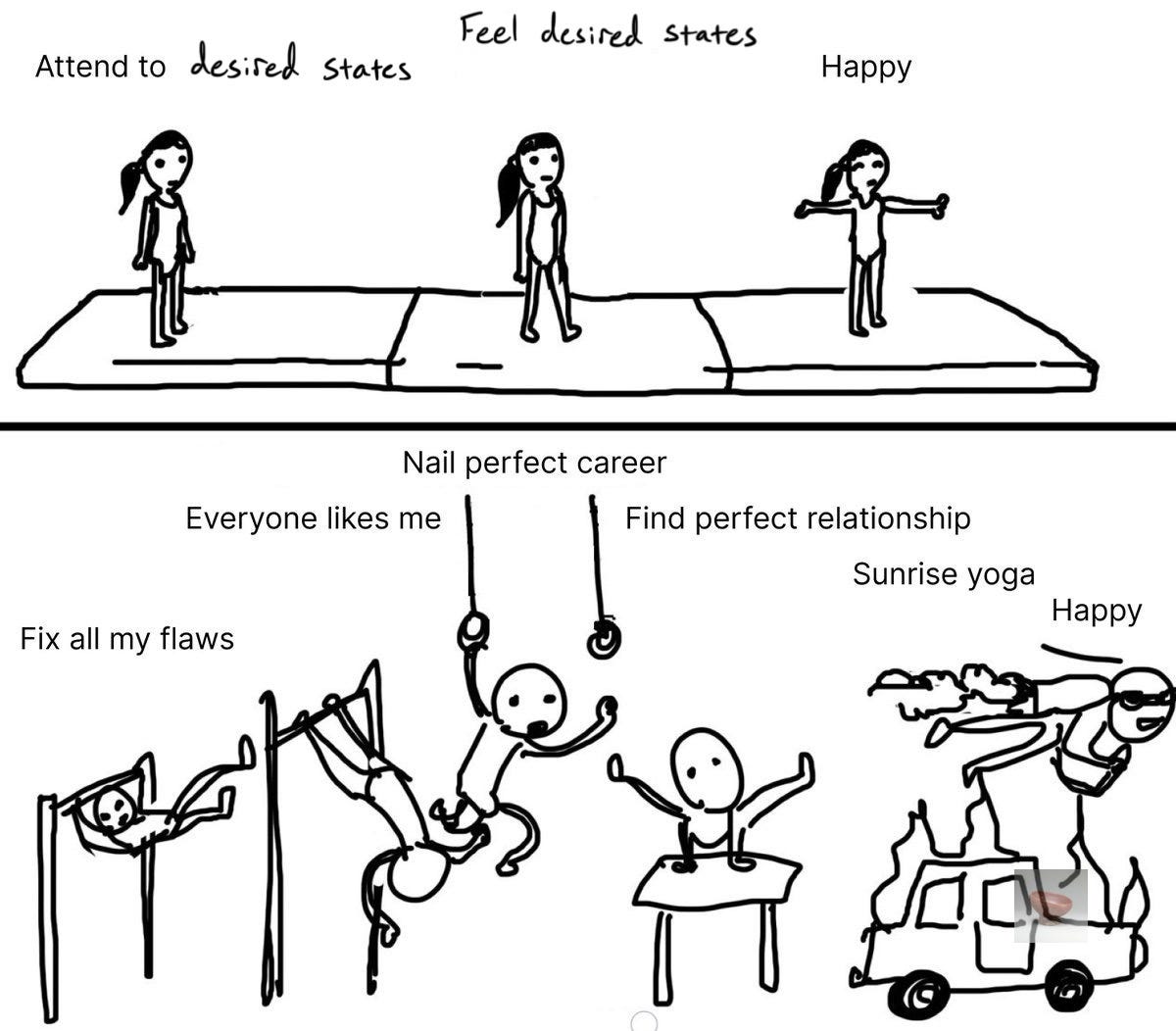
Core Transformation (CT) is a form of parts work, like internal family systems (IFS). But where IFS tends to focus on fears (defaulting to asking parts “what are you protecting me from” or “what are you afraid will happen if I feel this”), CT focuses on desires. The CT sequence is basically:
Find a part – focus on some part of your experience (a feeling, thought pattern, etc) that feels especially alive or “up” for you; let it coalesce into an imagined entity by feeling where it sits in your body, what it feels like somatically (shape, movement, texture), if there’s any imagery, emotional quality, or verbal content that comes up when you listen to it, etc. – it doesn’t have to be totally solid or personified, but you want to be able to have a dialogue with it. You’ll get the hang of this with a bit of practice.1
Welcome the part – thank it for being here, cultivate a bit of goodwill or metta towards it, get in touch with the feeling that it’s here because it wants something good for you. All parts of you want something good for you, even if they’re going about it with 4-year-old logic.
Ask the part what it wants – feel into the answer in the bodily felt sense, not just a cognitive/verbal idea of what the answer might or should be.
(If you aren’t clear on the difference, that’s ok! See Gendlin’s Focusing – you’re finding a handle for a pre-conceptual/pre-verbal embodied experience.)
Thank the part for its desire– even if it’s misguided or ignorant or causing you problems, get in touch with some felt gratitude for the part trying to take care of you. What a beautiful thing to want.
Feel into the desired outcome – get in touch with the felt sense of what it would be like to have what this part wants fully and completely.2 Let this spread as an embodied feeling through as much of your body as possible. (Some possible questions: If you could have [desired outcome] fully and completely, how would that feel? or: If you could do your job perfectly, what would that make possible?)
Ask what else the desired outcome gets you – ask the part: if you have that feeling, what does that get you that’s even better? What does it open up that’s even more important or more beautiful? This is basically step 3, but from a new starting point, asking about the desire behind the desire.
From here, repeat steps 3-6 recursively until you reach an outcome that feels like there’s no deeper/bigger/more important desire behind it. This end-of-the-outcome-chain feeling is called a Core State.
(For those who haven’t experienced this before, keep in mind that a core state is feeling what it would be like to already have one of your deepest desires met– the thing other surface-level desires are pointing to. It’s generally some flavor of deeply beautiful and blissful. It can be spiritual. It can be sparklingly magical or utterly simple. It can be new, like an undiscovered garden, or deeply familiar, like coming home.)Bask in the core state, enjoy it, feel it fully in the body
Walk back down the outcome chain – feeling what it’s like to have that desired core state feeling, revisit each of the previous steps and how they feel different if you already have the deeper state that the part was wanting.
[non sequential] If an objection, resistance, or blockage appears at any point in the above sequence, detour and do the whole above sequence starting with the objecting/resisting/blocking part. Some light resistances will step back if thanked for their contribution and asked nicely. If it’s a stronger objection, return to the original chain only once you’ve fully completed the objection’s outcome chain branch, reached a core state, and walked back down the chain.
A great thing about CT is that it’s a very simple, straightforward sequence of moves. While it helps to have someone prompt you along, take notes, and hold space for you to drop deeper in, I find it’s less important to have a highly skilled or trained facilitator than it would be in IFS or other forms of somatic therapy. The simplicity makes it well-suited to peer-to-peer guiding: you can easily do this with a thoughtful friend, or with an LLM if you set the prompt up right.3
Another great thing about CT is that it works surprisingly quickly to get you to deep bliss states. It feels like cheating sometimes: you mean by asking the hypothetical “what would it feel like to already have what I want,” I can just .... actually get the feeling that I want? After a bit of practice, it turns out the answer is usually yes. Your actions are strategies to change the external world to get the feelings you want, but you can also just access those feelings directly.
There’s a whole sidebar to explore here on what the fuck that means for how we live our lives. Maybe I’ll write on it in more depth sometime, but for now I’ll just say that it’s sort of an inverse or extension of the vajrayana thing where you learn to decouple feelings from reactions (e.g. feeling anger completely without lashing out).4 In CT, instead of decoupling reaction from feeling, you decouple feeling from stimulus. You find that you can get the desired feeling without the events that were supposed to cause that feeling. You can still go after the thing you want in the world, but doing that from a place of abundance or empowerment – rather than scarcity or grasping – tends to produce pretty different results.
It’s worth noting that CT isn’t totally easy for everyone. It helps to have a foundation in some kind of access practice like Gendlin’s Focusing or body-oriented Vipassana. Some people encounter mental fog or objections from parts that insist that “just getting what you want” isn’t supposed to be possible, or something like that. Troubleshooting CT practice would be a much longer exploration, and there are a variety of mental moves that can be helpful. I’ll just say here that if you’re trying it, please be patient, don’t blame yourself if it doesn’t work off the bat, and if you’re having a hard time, do consider working with a skilled guide.
I also want to emphasize that CT is not just about getting to blissful core states. The practice is goal-oriented, but that doesn’t mean the goal is the whole point. Even if it never gets you to a core state, or takes a long time to get there, learning and practicing CT can open up a lot. It can offer new ways to relate to aversive or “negative” feelings. It can help surface and untangle resistances or patterns that get in the way. It can open up access to your deepest desires and motivations. The exploration itself is a beautiful practice in self-intimacy. Moving towards core states without getting too attached to the outcomes can be a process.
Jhana practice and core transformation as a springboard
If you’re new to learning about jhana practice, I recommend starting here. In short, jhanas are deeply pleasurable, deeply absorptive, non-addictive meditative states.5 They can be profoundly beautiful, like finding secret rooms within yourself that hold renewable wells of pleasure, sweetness, and calm.
There are different approaches to accessing the jhanas, but a general sketch is that you start by cultivating some samadhi (focusing the mind, opening/harmonizing/unifying awareness), find a pleasurable feeling, and then enjoy/allow that feeling fully until that enjoyment fills your whole being, which might involve some recursive amplification where you enjoy the enjoyment (of the enjoyment) and the embodied feeling of enjoyment spirals upwards.
When practicing the jhanas, people generally use a “springboard” practice – you focus on something to get the felt sense of pleasure and sweetness flowing, then you “jump off” the focus object to turn awareness directly toward those pleasant feelings and let them echo and amplify into a full-blown jhanic state. Common springboards include breath practices that energize the body (like this), awareness practices focused on bodily pleasure (e.g. finding a felt sense of glowiness in the feet, hands, or heart, like this) and heart practices (e.g. cultivating feelings of love for oneself and others, and feeling what that love feels like in the body - you can find a variety of guided practices in this thread).
I’ve seen surprisingly little discussion, however, of using Core Transformation (or any parts work approach) as an entry point to jhana practice.
I think Core Transformation as a springboard deserves more discussion, for a few reasons.
(1) It’s easy to do, enjoyable, and can work surprisingly quickly.
At least for me, but I doubt only for me, an imaginal approach opens up samadhi and bliss states quite a bit faster and more reliably than e.g. energy body breathing or metta phrases. Core Transformation offers a kind of narrative immersion that leads naturally to absorption. Working with feelings and thoughts, rather than hoping they’ll quiet down and get out of the way, lets you ride whatever’s already at hand. You say yes to everything that comes and find the beautiful qualities already present until that beauty becomes all-encompassing.
As a beginning jhana practitioner, other approaches like metta phrases often felt like I was trying to make some pleasure or sweetness, or hoping for it to arrive. Your mileage may vary, but I found that Core Transformation felt more like finding the beautiful qualities beneath the current feelings, rather than cultivating them. It felt more like they were already there. That opens up deep states of loveliness very quickly.
(2) It has a built-in mechanism for working with the hindrances.
The first time I found my way into the first jhana, I immediately popped myself out of it by getting excited to tell a friend. But I’d been using Core Transformation as a springboard, so I found I naturally turned toward that over-eager part of me, thanked it for its positive intentions (connection! shared joy!), and asked it if it would be willing to sit and just feel the body with me. That allowed me to quickly find my way back into the jhanic state.
In Core-Transformation-based jhana practice, when another part comes up and gets in the way of jhana access, you have a ready-at-hand move to meet it with love and gratitude, understand it, and hold it in loving awareness until it either lets go or your practice session becomes about working lovingly with that hindrance.
A simpler, light-CT version: I like to welcome hindrance parts when they appear, thank them for their good intentions, ask if they’d like to sit and enjoy feeling their bodies with me, place them in an imaginal meditation hall in my belly, then return to the sit.
A stronger, full-CT version: performing the full CT sequence on a more stubborn or intrusive hindrance part can do a sort of vajrayana aikido move, riding the energy of its resistance or interruption (which is, after all, based in a well-intentioned eros of some kind) towards an absorptive bliss state as you feel the feelings of that part’s desired outcomes.
For readers asking “what are hindrances?”: hindrances are inner roadblocks commonly encountered by meditators. The hindrances, in classic buddhist teachings, are sense desire, aversion, sleepiness/dullness, restlessness/worry, and doubt (such as, in the case of jhana practice, doubting whether jhanic states are actually possible for you). Working with the hindrances when they come up – which they certainly will – is a major part of the process of jhana practice.
When doing Core Transformation as a springboard, you might find that hindrances met with loving awareness tend to step back and make room more easily than hindrances met with hostility. Or you might find that when you follow those hindrance parts to the desires at their roots, those desires and the core states beneath them can themselves become paths toward jhana. I’ve found this playful hindrance-aikido move very joyful.
(3) It points you directly toward integration: using the jhanas for healing & loosening psychological knots.
When you approach jhanas using Core Transformation as a springboard, you’re already working with psychological patterns. That makes it very natural to use the jhanas for healing and growth, rather than orienting towards them as a beautiful diversion.
An example: on a meditation retreat this year I was dealing with some difficult emotional stuff, and found a part of me that felt unable to be reached by other people. There was a visceral sense of not being able to be touched, as if this part were reaching for someone else and finding its fingers stopped a few inches away from their hands by some ghostly force field. I moved into Core Transformation mode with this part, and found my way to a strong sense of how it would feel to be touched in a completely satisfying, connected way. It felt like a warm bath for the heart. It felt like relief. That feeling of total satisfaction/connection amplified into solid second-jhana territory. It was achingly beautiful – more than I’d care to attempt translating into prose.
But the important part of that experience wasn’t the total satisfaction of the jhana. In fact, calling it a jhana feels like an afterthought – descriptively true but beside the point. What mattered was learning the visceral lesson that such a deep feeling of connection was available to me, and attainable within me, without anything changing in the external world. Something in me hadn’t known that – hadn’t known it was lacking that – and through this experience, for the first time, learned deep in the body how possible that sense of total connection might be for me.
When you enter the jhanas from a parts-work frame, you can be oriented from the start toward using them for healing. You can talk to the parts of you that think they don’t have what they need, and show them that everything they want is already there, if they just know how to look. The practice can loosen tension from a chronic sense of not-enoughness by providing a deep wellspring of inner resource. Or it can provide a pocket of deeply felt safety from which to explore the ways that we haven’t felt safe. It can be a powerful, transformational emotional experience.
I’d make an analogy to psychedelic therapy here. You can take MDMA just to explore the beautiful range of states of consciousness available to a human being. That can be a lovely thing to do. But for the deepest benefit, it’s generally richer to use it to process core wounds or get new perspectives on stuck emotional patterns. Jhanas, like MDMA, offer profound inner resource that we can use to ground and heal the parts of us that feel stuck, wounded, or starved of love and wellbeing. Integrating jhana practice directly with a healing practice like Core Transformation orients the whole thing toward deeper integration.
That’s been true in my own experience – maybe you’ll find it true for you as well.
Give it a try. May you find something beautiful along the way.
Postscript: Core Transformation and “contentful” vs. “bare” jhanas
There’s something here to be explored further about the value of exploring jhanas as not separate from narrative content and meaning. I haven’t found anyone writing about the distinction between what you might call bare jhanas (the absorptive state of pleasure, happiness, or peace entirely on its own, without a story about what the state means) and contentful jhanas (the absorptive state happening with some story still attached, like part of the narrative).6
It seems to me that most people I know getting into jhana practice are thinking about bare jhanas, cleanly delineated and numbered. There’s nothing wrong with that, but I wonder if they might benefit from a nudge to try practicing jhanas that aren’t cut off from story – like feeling intense absorptive pleasure as a part of offering a healing experience to a part with a deep unfulfilled need.7
To extend the psychedelic therapy analogy: the difference between bare vs. contentful approaches to jhana might be like the difference between a DMT pen and an Ayahuasca ceremony. In ceremonial uses of entheogens, the ceremony isn’t just facilitating the use of the medicine: the medicine facilitates the transformative, psychoactive richness of the ritual experience. The core “active ingredient” in both experiences may be the same, and people can get a lot of beauty and discovery from a DMT pen, but immersion in a narrative – a full-spectrum experience – opens up a whole world of meaning, healing, growth.
Jhanas can be like this too. You can just sample and enjoy the altered state, and that can be beautiful and valuable in itself. Or, you can use the altered state as a part of a deeper, more complex and meaningful experience, which might point you towards deeper and more complex impacts. I think of this as an approach to jhana practice that fits within Rob Burbea’s Soulmaking Dharma framework.
Appreciations etc: I got all of this CT intro from Romeo Stevens via Theo. For more in-depth explanations see Romeo Stevens’ blog post on core transformation, his more in-depth overview notes, and this interview between Theo and Romeo.
Huge gratitude to Theo for introducing me to Core Transformation and parts work more generally - if you’re looking for guidance in parts work approaches or opening up your inner world and somatic-imaginal practice, I highly recommend working with him.
Finally, If you’d like a hand trying out core transformation, I’ve been facilitating core transformation for a couple friends and would be happy to do a session with you on a PWYW or Dana basis (i.e. free unless you want to offer payment as gratitude). Disclaimer: I am not certified or formally trained in core transformation, but I do have a decent amount of experience holding space and exploring these practices, and I’d be happy to explore with you. To talk about that or anything else about this piece, I’m reachable by twitter DM @credorelief or by email at credorelief@gmail.com.
If you haven’t done any parts work, it’s probably helpful to practice Gendlin’s Focusing first, to get the hang of accessing and working with felt senses in the body. This is basically clearing a workspace, getting down into the imaginal plane (which can sort of feel like a light dream state? probably something abt theta waves, but that’s entirely conjecture) and getting used to the feeling of letting parts answer your questions instead of answering for them from your cognitive logic-mind.
You basically never want something just in and of itself – desires are always desires for mental/emotional states that we believe will come from some outcome happening in the world. See also: the more philosophical parts of Marshall Rosenberg’s Nonviolent Communication framework about wants/needs/strategies, or Joe Hudson’s “How To Make Great Decisions”, where Joe talks about how thinking is mostly oriented towards predicting how we’ll feel in an imagined future, so our emotions can do the actual decision-making.
I’ve been working on a prompt to get Claude to facilitate a basic core transformation sequence, but it’s not quite ready for prime time yet. I’ll come back and add it here when it’s ready. In the meantime, if you want an incomplete version, DM on twitter @credorelief.
On the vajrayana note: core transformation is very similar to Feeding Your Demons, which is a westernized form of Tibetan Chöd practice developed by Lama Tsultrim Allione. In my experience, CT starts with breadth while FYD starts with depth. CT proceeds through many small, iterative questions, while FYD asks a few deep questions and sits with them for a while. I’ve found FYD extremely powerful, both for emotional processing and for accessing rich and beautiful heart states, though I find myself turning to it when I want to process deeper or more difficult emotions, rather than for use as a springboard to bliss states – probably because it moves quite a bit slower than Core Transformation, so can move you through deeper waters, so to speak. FYD is worth trying, maybe if you’re dealing with something heavier or more stuck, or if you like more connection to a vajrayana lineage.
It’s worth mentioning that there are different approaches to jhana practice. Some focus on a numbered series of delineated states, the first through eighth jhana, and will offer descriptions of those states (which were first outlined in a 5th century Sri Lankan meditation text called the Visudhimaggha) and instructions on how to get into different ones. Others take a looser, more fluid approach, not as oriented around whether they’re “in a jhana” or which jhana they’re in, but instead practicing in a generally jhanic mode, maybe combining jhanic states with other imaginal practices. My personal inclination is toward the latter, though I see a lot of value in the former as well.
I have, however, heard discussion of this in anecdotes and informal conversations – suggesting that messy/blended/contentful jhanas seem more common in practitioners coming from zen or vajrayana traditions, whereas clean, Leigh-Brasington-style numeric jhanas seem more associated with a theravada background and approach. I would love to be pointed toward more discussions of this dynamic if anyone knows of them.
Here’s Rob Burbea, in his gold-standard “Practicing the Jhanas” retreat: Much more significant is when we are able to frequently practise and experience a jhānic state […] regularly enough that it functions as a more constant source, like a well that isn’t going dry, or a spring, and there’s a sense of replenishment that it brings, of rejuvenation, of energy. The energy is being, yes, replenished, rejuvenated, and a deep emotional well-being of different flavours and kinds, dependent on what jhāna we’re talking about. But that deep emotional well-being allows us or supports us, helps us, to stay steady, and to meet difficulties, to sustain our creative projects, the work that we’re doing, when there is difficulty; to sustain our service work, if that’s what we’re involved in, or our activism, or whatever it is, through the ups and downs, through the knocks, through the slog of that.” (From “PS - Playing in the In-Betweens”)
Thanks for sharing this! I don't have any experience working with the jhanas yet, but I've definitely experienced some very enjoyable Core States through Core Transformation practice. I also just did a training in The Wholeness Work and wonder about that as a portal into nondual/ Do Nothing meditation practices.
This was fascinating thank you! As someone coming more from the meditative side, thinking about it (backwards? ish?) into IFS (which I have not done with a practitioner but have read/journaled a bunch on), was a real eye opener! I love the connections!